|
1)
What does "Gospel" mean?—
a word of
Anglo-Saxon origin, and
meaning
"God's
spell", i.e.,
word
of God,
or
rather,
according
to
others, "good
spell", i.e.,
good news.
It is the rendering
of
the
Greek
evangelion,
i.e., "good
message." It denotes (1) "the
welcome
intelligence of salvation
to
man as
preached
by
our
Lord
and
his followers.
(2.) It was afterwards
transitively applied to each
of
the
four
histories
of
our
Lord's
life,
published
by
those who are therefore
called
'Evangelists'.
Writers
of
the
history of
the
gospel
(the evangelion). (3.) The term
is
often
used to
express
collectively the
gospel
doctrines;
and 'preaching
the
gospel'
is
often
used to include not only the
proclaiming
of
the
good
tidings,
but the
teaching
men
how
to
avail
themselves
of
the
offer
of salvation,
the declaring
of all
the
truths,
precepts,
promises,
and
threatenings
of Christianity."
It is termed "the
gospel of
the
grace of God"
(Acts
20:24),
"the
gospel of
the
kingdom"
(Matthew
4:23),
"the
gospel of Christ"
(Romans
1:16),
"the
gospel of peace
(Ephesians
6:15),
"the
glorious gospel,"
"the
everlasting gospel,"
"the
gospel of salvation"
(Ephesians
1:13).
(
res-2c3 )
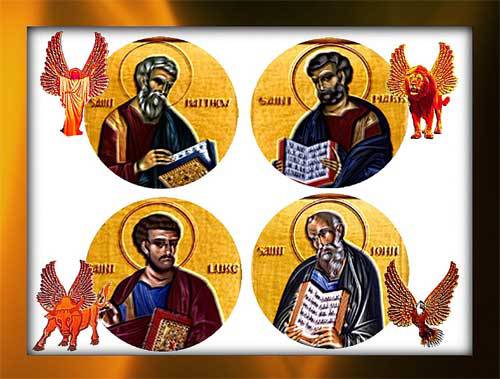
2) Overview
of Each Gospel;
a) Matthew shaped
his account for the Jewish
reader, emphasizing Jesus
fulfilled the Old Testament's
prophecies about the Messiah. (
res-3e )
b) Mark shaped
his account for the Roman
(Gentiles), to
show that Jesus was a man of
action. (
res-3e )
c) Luke shaped
his account for the Greek
(Gentiles), to
show that Christ was the ideal
human being. (
res-3e )
d)
John
shows Jesus complete deity, from
beginning of time to the end of
time.
(
res-3e )
3)
About Each Author & Study
Notes
a) Matthew's,
Gospel - (Matthew 1:1 to 28:20)
- (from
Easton's Bible Dictionary) -
gift of God, a
common Jewish name after the Exile. He was the son of Alphaeus,
and was a publican or
tax-
gatherer at
Capernaum........ Go to
"Who is Matthew?" to learn
more about him.
(
res-2c3 )
Who is Matthew? - Matthew
1:1 to 4:22 - Matthew
4:23 to 5:42 - Matthew
5:43 to 7:20 -
Matthew
7:21 to 9:13 -
Matthew 9:14 to 12:21 - Matthew
12:22 to 13:58 - Matthew 14:1 to
16:28 -
Matthew 17:1 to 19:12 - Matthew 19:13 to
21:27 - Matthew 21:28 to
24:35
- Matthew
24:36 to 26:46 -
Matthew 26:47 to 27:66
- Matthew 28:1 to
28:20
b) Mark's,
Gospel - (Mark
1:1 to 16:20)
- according to (from
Easton's Bible Dictionary)-- It is the current
and apparently well - founded tradition that Mark
derived his information mainly
from the discourses of Peter. In
his mother's house he would have abundant opportunities of
obtaining information from the
other apostles and their
coadjutors, yet he was "the
disciple and interpreter of
Peter" specially
........ Go to "Who is
Mark?" to learn more about him.
(
res-2c3 )
Who is Mark? - Mark
1:1 to 1:45 -
c) Luke's,
Gospel - (Luke
1:1 to 24:53) - according
to (from
Easton's Bible Dictionary) —
was written by
Luke. He does not claim to have been an
eye-witness of our Lord's
ministry, but to have gone to
the best
sources of information within his reach, and to have written
an orderly narrative of the facts (Luke 1:1-4). The authors of the first three Gospels, the
synoptic, wrote independently of
each other. Each wrote his
independent narrative under the
guidance of the........
Go to "Who is Luke?" to learn
more about him.
(
res-2c3 )
Who is Luke? - Luke
1:1 to 2:20 - Luke
2:39 to 3:22 - Luke
3:23 to 5:16 -
d) John's,
Gospel - (John 1:1 to 21:25) - according to (from
Easton's Bible Dictionary) - The
genuineness of
this Gospel, i.e., the fact that the apostle John
was its author, is beyond all
reasonable doubt. In recent
times, from about 1820, many attempts have been made to impugn its
genuineness, but without
success. The design
of John in
writing this Gospel is stated by
himself (John 20:31). It was at one time supposed that he wrote for the purpose of
supplying the omissions........
Go to "Who is John?" to learn
more about him.
(
res-2c3 )
Who is John? -
|